
Features that make coding with AI feel like magic.
Fabric helps professional developers do their best work by bringing structure to AI coding with spec-driven development.

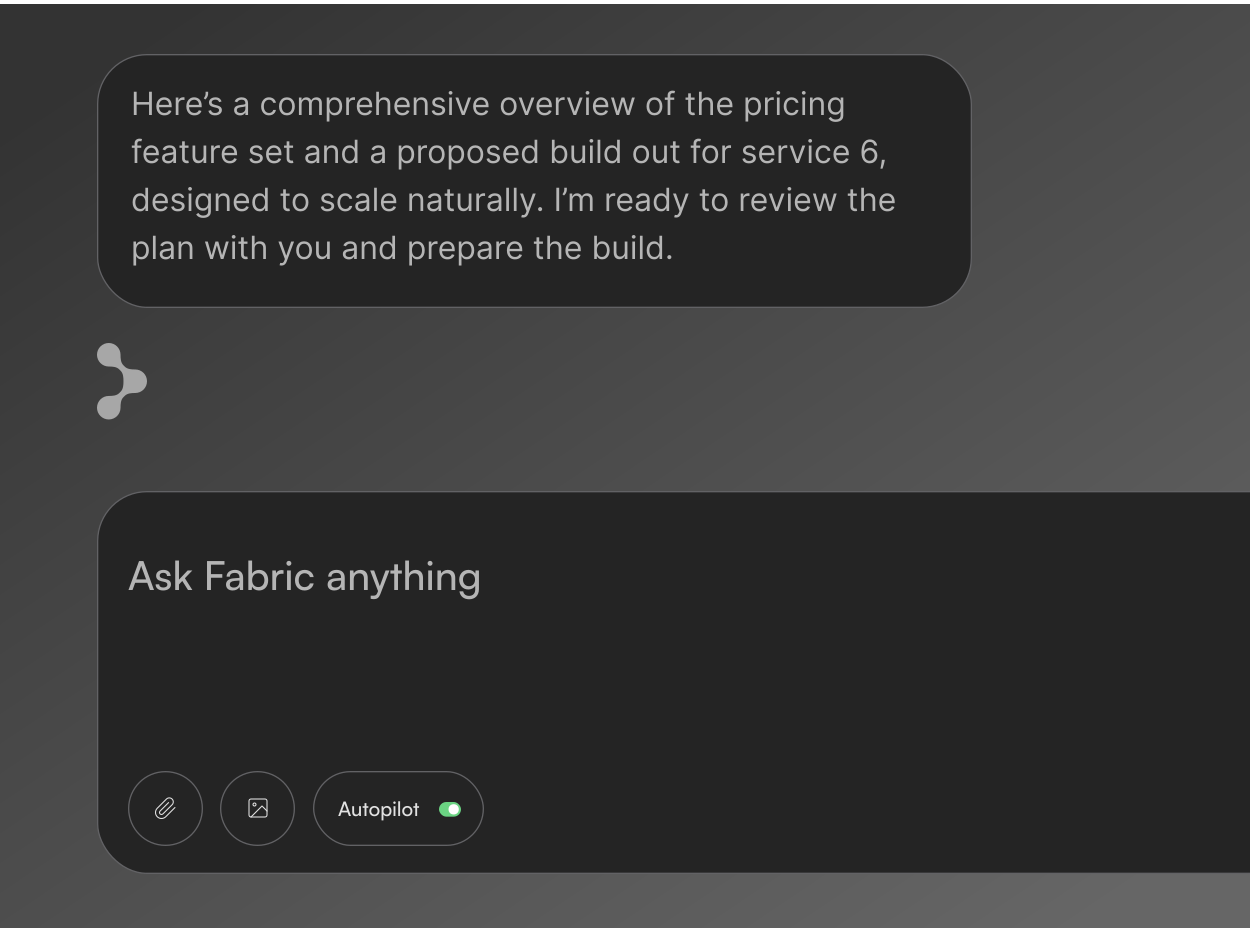
AI is changing how software is built.
Fabric helps your entire team deliver ambitious projects. Modern engineering teams are powered by Fabric.
64%
Code is written by AI
100M+
Lines of Enterprise code written
5x
Increase in average throughput
87.9%
Accuracy with fewer-shot prompting
Powerful, and Flexible.
See under the hood the powerful system architecture that gives developers speed while maintaining control in large codebases.
Parallel Execution
Fabric’s agentic process takes your natural language prompt, turns it into clear requirements and acceptance criteria, then executes discrete tasks in parallel.
Visual Programming
Fabric analyzes your codebase and comes up with architecture and system designs to meet your needs, visualized beautifully in our Canvas.
Intelligent Feedback
Intuitively provide feedback across every surface to guide Fabric from 90% → 100%. We take the feedback and update Fabric’s memory to make future workflows easier.
Built for Agentic Development and Institutional Trust
Autonomous agents, natural interaction, and governed execution–designed for regulated, large-scale software engineering.

Quality Code, Everytime
Precise Code is delivered across large codebases with the power of frontier models and advanced graph context management.

Talk Naturally, Work Intuitively
Conversational Superpowers allow you to code at the speed of speech. Voice prompting is 4X faster than typing.

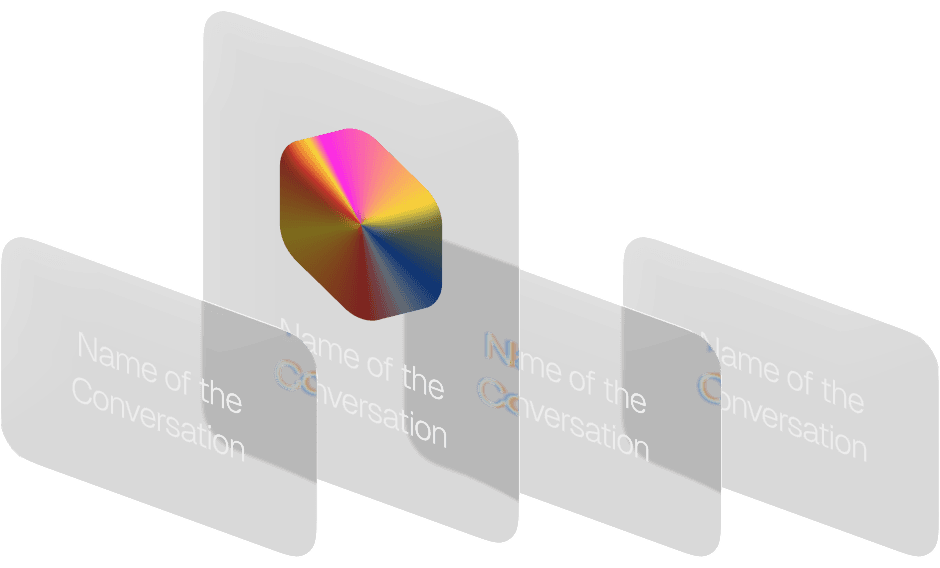
Tame Complexity with Advanced Steering
Autonomous Agents work independently on development tasks, maintaining context, and learning from every interaction.
AI Coding with Enterprise-Grade Capabilities
Sign UpBuilt for Professionals
Everything you need to go from vibe coding to viable, production level code.
Built for the AI-age
Multi-modal chat, spec-driven development, agents - Fabric is the best platform for the job in a fresh development experience.

Advanced Context Management
With Canvas and Graph, Fabric understands the intent behind your prompts and helps you implement complex features on large codebases, in fewer shots.

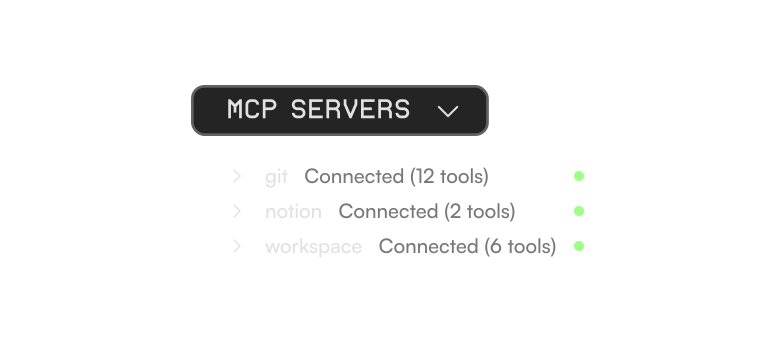
MCP comes Native
Connect your docs, databases, APIs, and more with native MCP integration, so you can bring your world where you work.
(Coming soon)
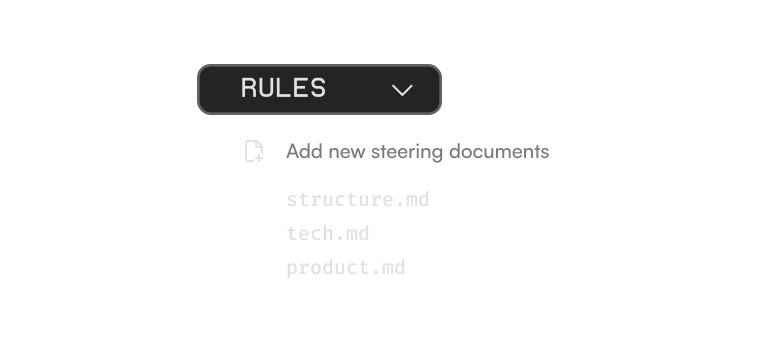
Your Code, Your Rules
Configure how you want Fabric to interact with each project, or globally, via Rules. Add context, coding standards, prefered workflows or tools with a simple command.
Powered by the State of the Art
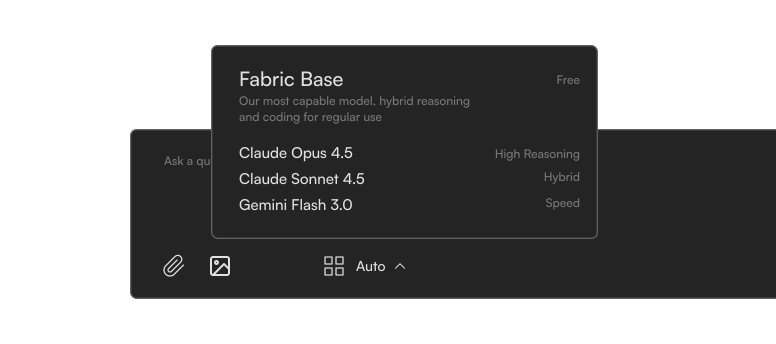
Pick a frontier model yourself, or choose Auto and let Fabric use the right mix of models for each task.
Go Autopilot
Let Fabric autonomously run large tasks on its own without needing step-by-step instructions. You stay in control, especially when running scripts or commands.

Per Prompt Credit Usage
See how many credits each prompt consumes, in real-time, so you’re always in control of your spend.

Show, Don’t Tell
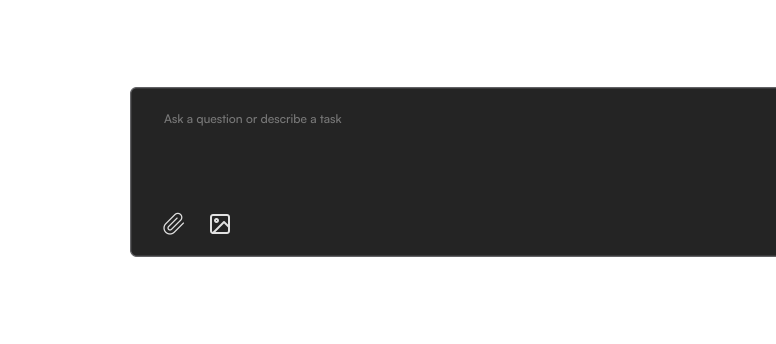
Drop an image of your UI design or a photo of your architecture and Fabric can use it to guide its implementation.
Privacy is Built Into Fabric
With enterprise-grade security and privacy, you can ship your best work with confidence. Your prompts aren’t our product. Code freely.

No Training on Your Code
Hosted models are reached only through providers bound by zero-data-retention agreements. Your code remains yours.

Private Data Stays Private
Run fully local and your data never leaves your machine.

Zero Data Retention on AI Inference
Prompts and code sent to Fabric-hosted models are processed to generate a response, not logged, and never used for training. Our inference providers are bound by signed zero-data-retention agreements.

Modern Security Standards
Deploy on-premise or air-gapped, so regulated workloads stay under your own controls and authorization.

Encryption Everywhere
Your data is encrypted in transit and at rest.

Continuously Reviewed
We review and improve our security controls on an ongoing basis.

On-Prem/VPC
Fabric supports offline, air-gapped and sovereign deployments.

Full Transparency
Usage analytics that show how your team uses AI. Enterprise SSO and similar controls are on our roadmap.
Zero data retention applies to AI inference. A few features you choose to use keep data for a limited time: bug reports you send us, voice transcription, and remote-access messages until they are delivered (Privacy Policy, Sections 3.4 to 3.6). An enterprise organization can also switch on conversation archiving for its own members, who are notified and must acknowledge it before anything is copied, unless the owner turns the notice off after confirming staff were told another way. Individual accounts, free or paid, are never archived. Privacy Policy, Section 3.8
Frequently asked questions.
Fabric is an agentic AI coding platform designed to accelerate software development with an AI that codes alongside you – secure, context-aware code generation that always aligns with your standards and scales with your team.
Because most IDEs and AI copilots were not designed for governed, sovereign, or agentic development. They assume permissive data flows and external SaaS control, which many regulated environments cannot accept. Fabric works with the models you choose, including local ones, and can be deployed on-premise or air-gapped, so AI-assisted development is possible where consumer tools cannot be used.
Yes. Fabric-hosted inference is processed only by providers bound by zero-data-retention agreements, and we never use your data to train models. Data is encrypted in transit and at rest. Run fully local and your data never leaves your machine. For regulated environments, Fabric can also be deployed on-premise or air-gapped. Enterprise teams can choose to turn on an organization archive of their members' conversations, described in the Privacy Policy.
Enterprise terms are agreed with each organization, based on how and where it deploys Fabric. Talk to our sales team to discuss them.
Yes. Fabric can be deployed on-premise or in a private cloud, including offline and fully air-gapped configurations, so organizations can adopt AI-assisted development without exposing code or workflows to external services.